
Montgomery County Directory Holdings
The historical shelf is not one continuous set. The Alabama Department of Archives and History city-directory finding aid proves surviving Montgomery volumes from the nineteenth century into the twenty-first. The Montgomery City-County Public Library holds a separate local collection, while Montgomery County Archives identifies both ordinary and cross-reference directories. Online access is selective. In-person research remains central because many volumes are physical or on microfilm.
| Collection | Verified span | Where held | Access |
|---|---|---|---|
| Montgomery city directories | 1859-60 through July 2007, with gaps | ADAH | Finding aid, microfilm, and physical volumes |
| Cross-reference directories | About 1982-2008 | County Archives and ADAH | Address-to-name research in person |
| Telephone directory | September 1949-June 1952 | Library of Congress | 650 images online |
| Montgomery Room directories | Years not listed in public policy | MCCPL main library | Restricted, noncirculating use |
| County estate files | 1820s-1940s | ADAH research site | Name and keyword index, then microfilm |
The run includes early microfilm for 1859-60, 1866, 1873, 1878, several editions in the 1880s, and 1891. Printed boxes then cover many, but not all, years from 1880 through 1990. Later regional and cross-reference products continue through July 2007, and the County Archives lists holdings into about 2008. A missing year in the list is a collection gap, not proof that a person had left Montgomery County.
Montgomery Room Directory Shelf
The Juliette Hampton Morgan Memorial Library keeps the Montgomery Room at 245 High Street. Its local-history holdings include printed directories, high-school yearbooks, microforms, and vertical files. Materials do not circulate, and access is restricted. Reference staff should confirm the desired year and current conditions before a visit. The published use policy asks researchers to reserve at least 24 hours ahead, especially for weekend work, and requires staff presence while materials are used.
Staff handle copying and scanning. The policy lists black-and-white copies at $0.20 per page, bars food and drink, and requires an adult with researchers younger than 15. The library's genealogy resources also include on-site tools such as Ancestry Library Edition, Heritage Hub, and Newspapers.com. Those databases can connect a directory hit to an obituary, census household, or later notice without treating the directory entry as a complete life record.
The manifest capture of the library's genealogy landing page shows the digital starting point for that research.
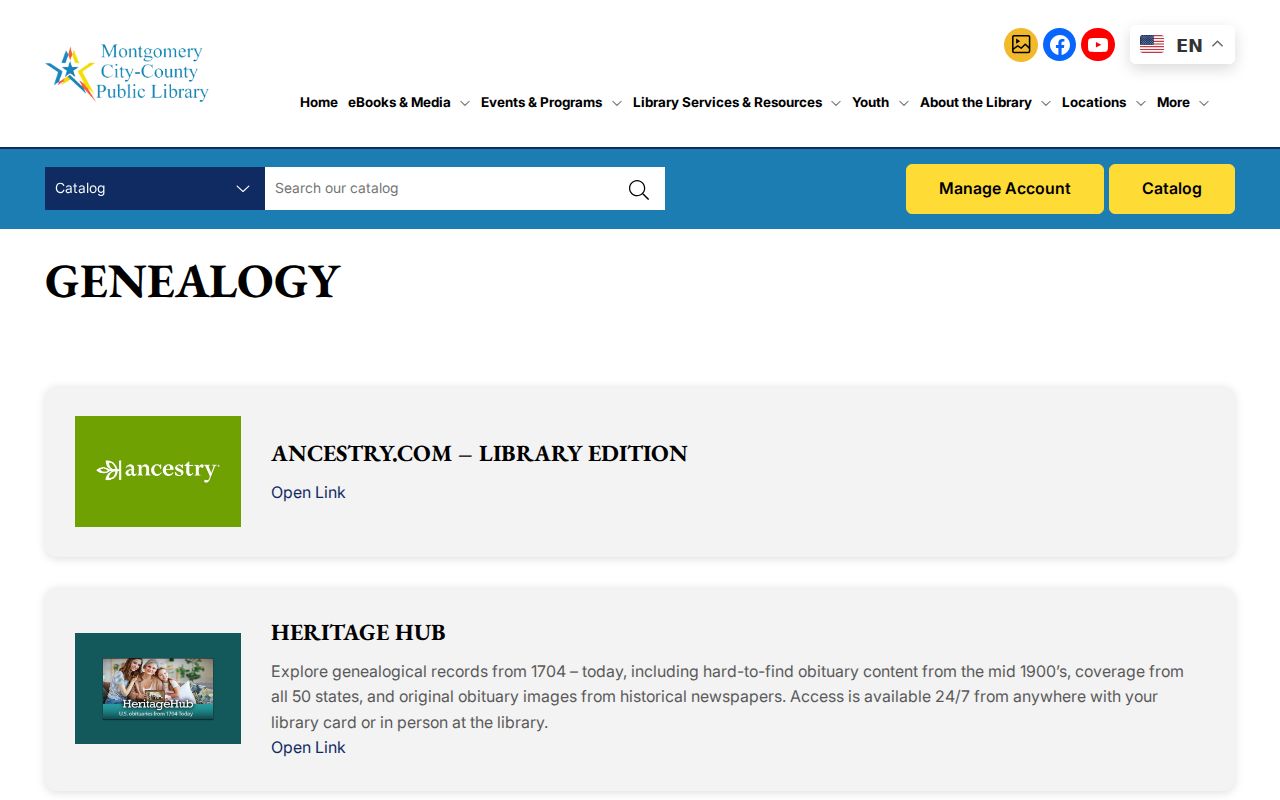
The screen is a gateway, not a substitute for staff confirmation of the restricted Montgomery Room shelf.
Montgomery Publication Survival Trail
The archival story starts with an 1859 lead, but survival is uneven. Montgomery County was formed in 1816, Montgomery became county seat in 1822, and the city became Alabama's capital in 1846. Early catalog searches may also encounter Alabama Town, East Alabama, or New Philadelphia. Place names and county boundaries shifted while some families stayed put.
| Period | Directory evidence |
|---|---|
| 1859-60 | Earliest verified Montgomery microfilm listed by ADAH |
| 1866 | Perry & Smith volume with names, trades, workplaces, and boarding clues |
| 1878 | Beale & Phelan city directory and local history |
| 1893-1990 | Broad printed run with multiple publication gaps |
| 1993-97 | Greater Montgomery, Prattville, and Wetumpka cross-reference series |
| Through 2007-08 | Later Montgomery and cross-reference holdings at ADAH and County Archives |
Publisher names must come from each title page. The 1866 volume is Perry & Smith, and the 1878 volume is Beale & Phelan. The finding aid does not identify every twentieth-century publisher, so the full Montgomery volume run should not be assigned to one publisher without checking each title page.
Note: Directory omission may reflect a publication gap, a listing rule, or a recent move rather than a resident's absence from Montgomery.
Reading Montgomery Directory Entries
The abbreviation page should be copied before any Montgomery directory entry is interpreted. The inspected 1866 scan defines terms such as ab for above, bet for between, nr for near, opp for opposite, clk for clerk, h for house, bds for boards, and wid for widow. Early addresses may use corners and landmarks instead of modern street numbers.
| Indexed name | The person or business placed in alphabetical order |
|---|---|
| Trade | An occupation, sometimes paired with an employer or work site |
| House clue | A numbered street, corner, boarding house, or relative position |
| Household clue | A spouse, widow notation, or boarding-house keeper |
| Business clue | A partnership, institution, office, or room above a business |
One sample describes Win Adams as a printer at the Advertiser office who boarded with Mrs. Gillen at Coosa and Tallapoosa. That supports listed occupancy and work context. It does not prove he owned the property. Optical character recognition is also imperfect, so the scanned image controls when the searchable text differs.
- Criss-cross directory
- A later format arranged by street or address, letting a researcher move from place to listed name.
- Householder index
- An address-centered list of the adult or household name chosen by the publisher.
- Abbreviation key
- The volume's own guide to shortened words and symbols, which may differ by year or publisher.
Digitized Montgomery Directory Volume
A fully scanned volume can answer questions that a catalog line cannot. The digitized 1866 Perry & Smith directory permits page-by-page inspection of residents, trades, boarding places, businesses, and historical material. Search text is useful for discovery, but the page image is needed to confirm spelling, punctuation, and the relation between adjacent entries.
The captured digital viewer illustrates that image-first method.
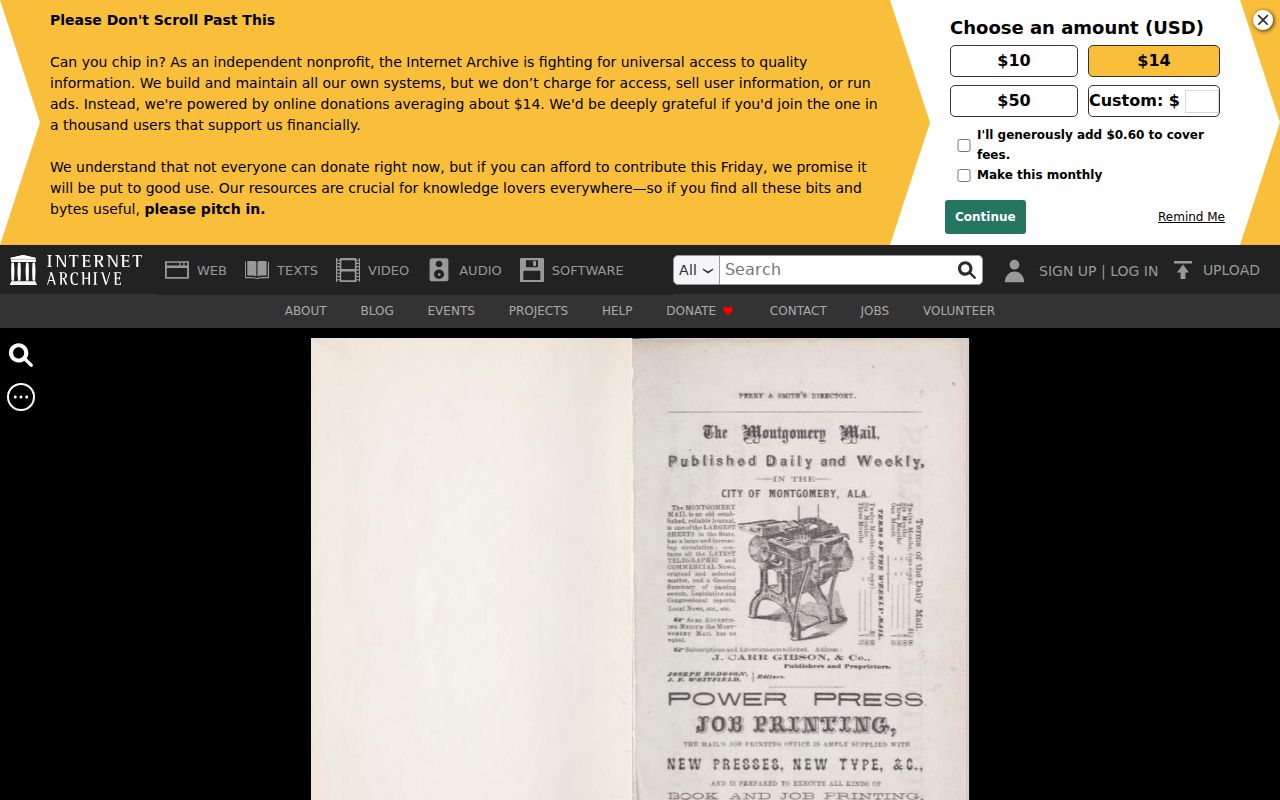
When text search misses initials or a short form, browse the alphabetical page range and inspect nearby entries by eye.
Montgomery Cross-Reference Directories
Alphabetical and reverse searches answer different questions. A surname list starts with a person. A cross-reference directory starts with an address, then identifies the person or business the publisher listed there. Montgomery County Archives dates its cross-reference holdings to about 1982-2008, while ADAH documents the Greater Montgomery, Prattville, and Wetumpka series for 1993-97.
That regional series is especially useful when a household moved past the City of Montgomery line. It preserves an address-to-name route across a wider suburban area. Still, the listed name may be an adult occupant, a business, or a phone subscriber. It is not a full household roster. Modern address-keyed ownership belongs in the Montgomery County street directory, where parcel and deed evidence can be kept separate.
Trace Montgomery Families by Directory
A sound Montgomery County city directory trail follows names and places across more than one edition. Census years help test the household between annual or irregular volumes. Federal census schedules are released after 72 years, so the 1940 and 1950 households can be paired with nearby directory editions. Deeds, estate files, and obituaries then address ownership, death, and heirs.
- Establish the street spelling and number used in the target year. Historic corner, near, and opposite descriptions may require a map or adjacent entry.
- Search the surname section and copy the complete entry. Record the abbreviation key and the page image, not just automated text.
- Compare the editions before and after it. Track changes in spouse, trade, workplace, and address while marking years that are missing.
- Use a cross-reference section, when available, to inspect the address and nearby listed households.
- Pair 1940 or 1950 directory evidence with the matching released census, then test deaths or moves through estate, obituary, and deed records.
A person who vanishes may have moved, died, changed a listing, or fallen into a publication gap. The next record should test those options. A later directory, obituary, estate file, or deed is stronger than a guess based on silence.
Montgomery Occupants and Deed Owners
A city directory identifies a listed occupant at publication time. A recorded deed identifies legal ownership. The two facts may match, but they need not. A boarding-house entry, leased home, delayed move, estate, or owner with another mailing address can create a mismatch. Montgomery County's research trail is clearer when each source is allowed to prove only what it records.
Keep the roles distinct. Directory listing means published occupancy or contact; a Probate deed supplies ownership, and neither source alone names every household member.
For an older address, capture the directory name and wording first. Then search the relevant deed or tax record by owner name and legal description. If the names differ, do not merge them. Instead, add the year, source type, and exact relationship shown. This comparison is a useful correction to the myth that an address listing always identifies its owner.
Montgomery Directory Gaps and Archives
When a city directory year is absent, nearby collections can keep the trail moving. Montgomery Room yearbooks can identify classmates. Its vertical files and microforms add local context. ADAH holds newspapers, maps, church records, county microfilm, and a Montgomery County Estate Files Index spanning the 1820s through the 1940s. County Archives finding aids also point to historical societies, court groups, subject files, and civic collections.
The ADAH research catalog is the main discovery point for those state-held records. Its estate database searches Name and Keyword(s), after which County Records on Microfilm helps locate the file. ADAH also offers remote research for one surname and up to four sources, with a stated charge of $15 for Alabama residents or $25 for out-of-state researchers. The service includes 20 copies, then charges $0.25 per page, and commonly takes two to three weeks.
Institutional collections may fill narrow gaps. Alabama State University, Auburn University at Montgomery, and Huntingdon College maintain catalogs, yearbooks, or archives tied to their communities. Church and synagogue records vary by donor limits. Newspaper and obituary evidence should be paired with a certificate, deed, court file, or directory image before a claim is treated as settled.